It was as if the world was conspiring against me to keep me from going to Iceland. I had started planning for this trip in 2020 and something or the other, including the mighty coronavirus, put a spanner.
But at last, I could visit this land, which arose from the ocean, after a volcanic eruption. A tiny island of contrasts, where you can see volcanos and glaciers, active flaming volcanos and dormant ones, high mountains and deep gorges, icebergs and lava rocks, hot smoldering springs and frozen streams, gorgeous waterfalls and dry arid land, moss covered dark basaltic and granite rocks with oasis of lush green farms—nature in its bipolar extremes.
But to reach Iceland from India, we had our first stop at Helsinki. My co-passenger in the flight, a native of Finland, told me that I could do reindeer rides in the city center, and I actually thought he was serious but alas! The weather was rather unwelcoming, rainy, cloudy, misty, windy and very cold. But we have come so far, so a city tour is a must.
In the half day we had, we visited the Church of the Rock or Rock Church (Temppeliaukio kirkko), a Lutheran church in the Toolo neighborhood, built directly into the rock. It is fairly new and was consecrated in 1969.
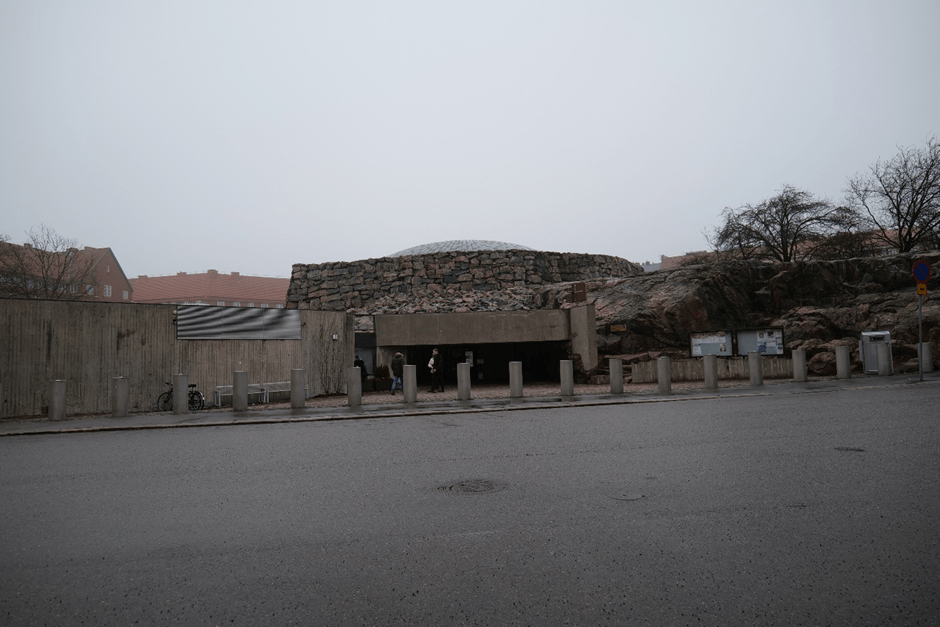
The area of Toolo, in spite of the dreary weather, seemed sprightly, with multi-colored row houses, shopping plazas, twinkling streetlights, brignt neon lights, lightening up the place.
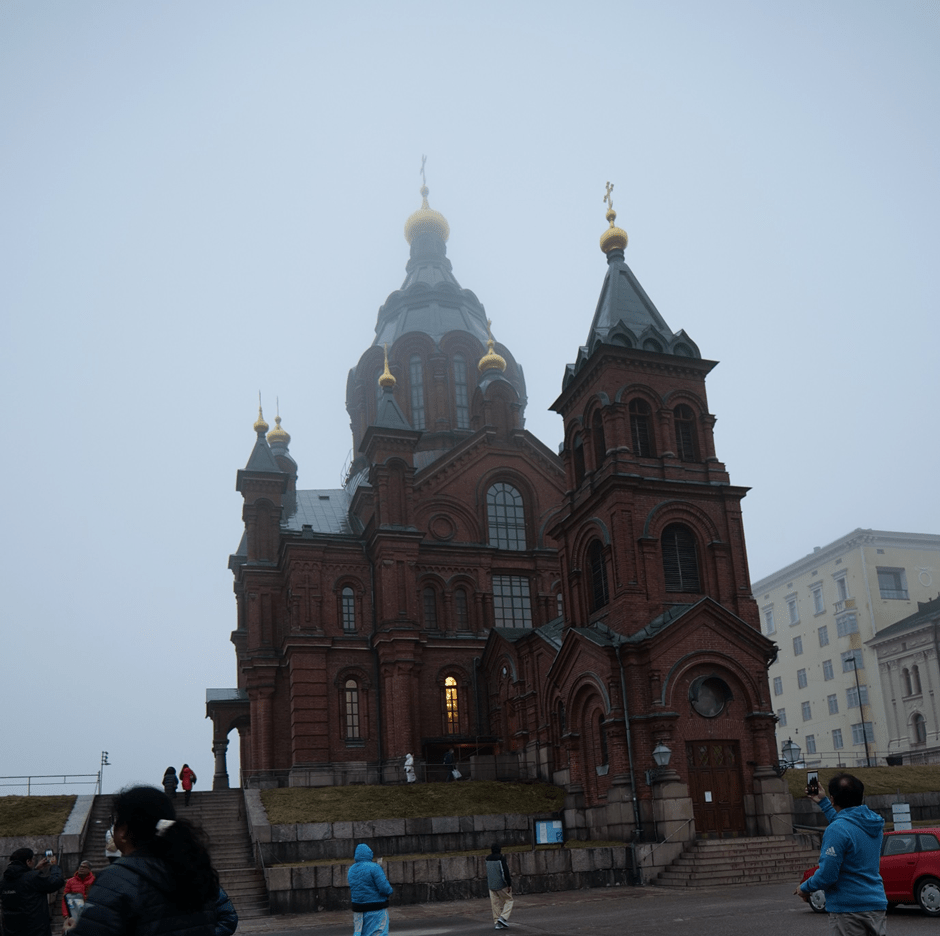
Dominating the skylines, and situated at a height, is the Uspenski Cathedral. Brick red and imposing, it is a Greek Orthodox church built when Finland was under Russian occupancy, during the reign of Alexander II.
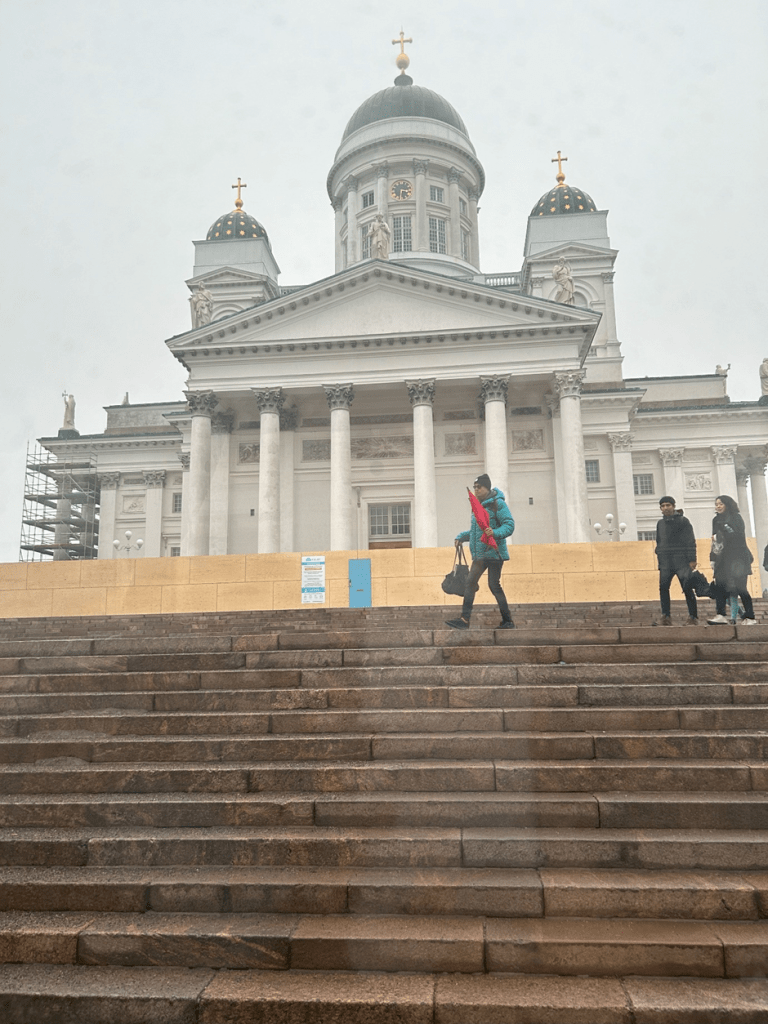
Yet another church, Helsinki Cathedral, in contrast white with a green dome and perched atop 50 stone steps. Large statues of the 12 Apostles are placed on the apexes and corners of the roofline. This is an Evangelical Lutheran church. This is also known as Nicholas Church, after Tsar Nicholas I.
In front of the church, also known as Senate Square, there is a statue of Alexander II, who was much loved and during whose reign Finland had prospered.
The Senate Square is surrounded by the Government Palace, which houses the Prime Ministers office, Justice and other important government officials.
The Finnish were ruled by Sweden for many centuries and then came under Russia and finally was liberated in 1917. The foreign influence in the architecture is apparent. The older churches of Uspenski and Helsinki cathedral were built during Russian rule and they have been built on a higher land, facing Russia, their massive structure showing dominance over their Lutheran subjects.
Not just churches, we visited the Olympic stadium, Siltasari, house of the Parliament, and perhaps the most impressive one was the Central Library in Oodi. It is shaped like a double helix structure, built up to 3 floors. Stacked with books wall to wall. The readers are aided by a Robot, who can help us fetch a book on request. The library also houses a gaming room, AV room, recording studio, music room, sewing area, 3 D photoprinting, and many other items of general public usage, all free of cost except for the material charges. The place was crowded because it was a weekend but still so well maintained. It was heartening to see young children lost in reading books.
As we travelled through the rain and fog laden city, we saw the inlets of the Baltic sea, white and frozen as it neared the land and blending into the dark Prussian blue sea, as far as you can see through the mist.
One thing was amply clear, being ruled by Swedes and Russians in the centuries before, the Finnish country is rich in history and politics. But so is the passion to keep the Finnish language and native culture intact and thriving. I could see the sense of pride in nurturing the language, encouraging local produce and investing in propagating their distinct heritage, across the narrow strip of the country they are.
While the weather wasn’t on our side, the hospitality was unbeaten and as I left the next morning, trudging over the grounds laden with thick coat of crunchy snow, I promised that I will come back in a different season, when Finland is in its colorful glory, with its blossoming forestry and thousands of pristine lakes.
Kiitos Finland!!
So finally the next morning, we hovered over Keflavik, and I peered out of the window to catch a glimpse of this island, which had been so elusive to me.
Sadly, the sky was laden with clouds and even after the aircraft broke through them, the mist couldn’t let me see a thing. We landed in Keflavik amidst rain and mist and bitter cold winds.
Immigration clearance was fast and smooth and we boarded a bus to go to Reykjavik but the weather didn’t let me see much outside. Still playing hard!
Through the rain covered windows, I saw the lava rocks, granites and basalts, black soil, and complete lack of flora. Here and there stones were piled together in a pyramid form. That was significant as the Icelanders believe in Elves, and they believe that the elves live under these rocks. Children are taught never to throw stones for if an elf is hurt, he may hunt them down and kill them. Gross, but a good method to teach them safe practices specially when you have rocks and stones lying around in abundance.
As we neared the city of Reykjavik, we saw a mix of modern and old buildings. The modern apartments were about 3-4 floors only with balconies covered by glass. Interspersed amongst these modern structures were multi-colored Viking houses. The houses wore bright colored exterior which help in removing the gloom and dreariness of the long cold sunless winters. Later we learned how these Viking houses were built to insulate from the cold. The outer structure is aluminum, followed by wool or thermal materials, and then another layer of aluminum or wood. Just one entry/exit door and a small window. This is how the Vikings of the yore kept themselves warm over the harsh winters.
The city of Reykjavik, the capital, houses about 60% of the total of 380k population of this country. Coming from a country which has a billion of us, this is incredulously small!
Our first sightseeing was the iconic Sun Voyager. This was sculpted by Jon Gunnar Arnason. It is an ode to the sun and depicts the heritage of Iceland–its sea faring Viking ancestors who landed in this island, when it was still an unknown and undiscovered territory. Along with that, it is also a nod to the future of Icelanders, of their dreams and hopes.
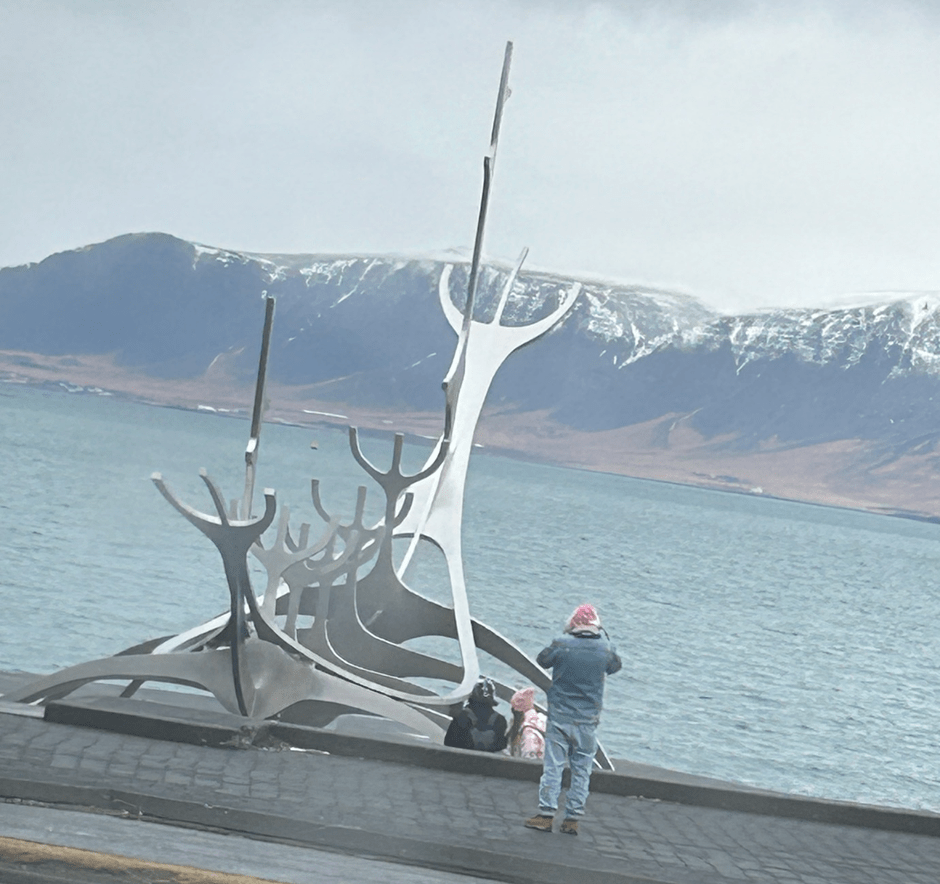
This landmark overlooks the inlet of north Atlantic Ocean which is bordered by the Askjia mountain range. This mountain range protects Reykjavik from devastating sea storms.
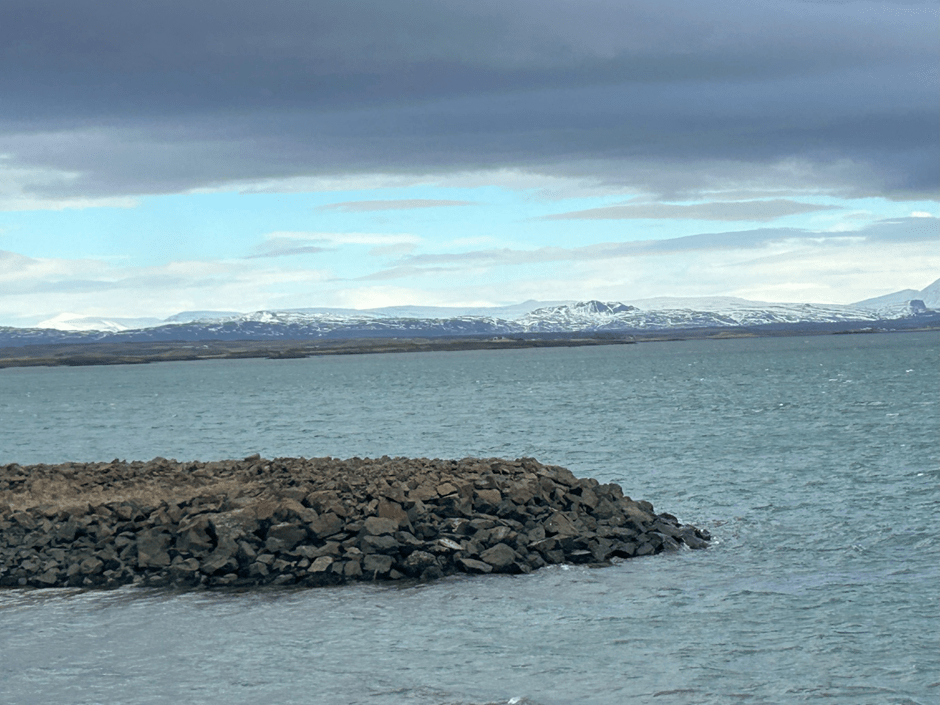
Close to the Sun Voyager is the Harpa, a concert hall, with distinct glass façade with colors of the basaltic rocks in Iceland. On certain angles and certain light conditions, it gives reflections of the aurora borealis.
It is surrounded by downtown buildings like Edition, the only 5 star hotel, shopping centers, banks and private corporations.

Churches form a big sight seeing centers here too and the most imposing is the Hallgrimskirkja. It is a Lutheran church, largest in the country, atop a hill and a clearly visible landmark of the city. Its distinctive structure is the organ pipe like columns with a central spire.
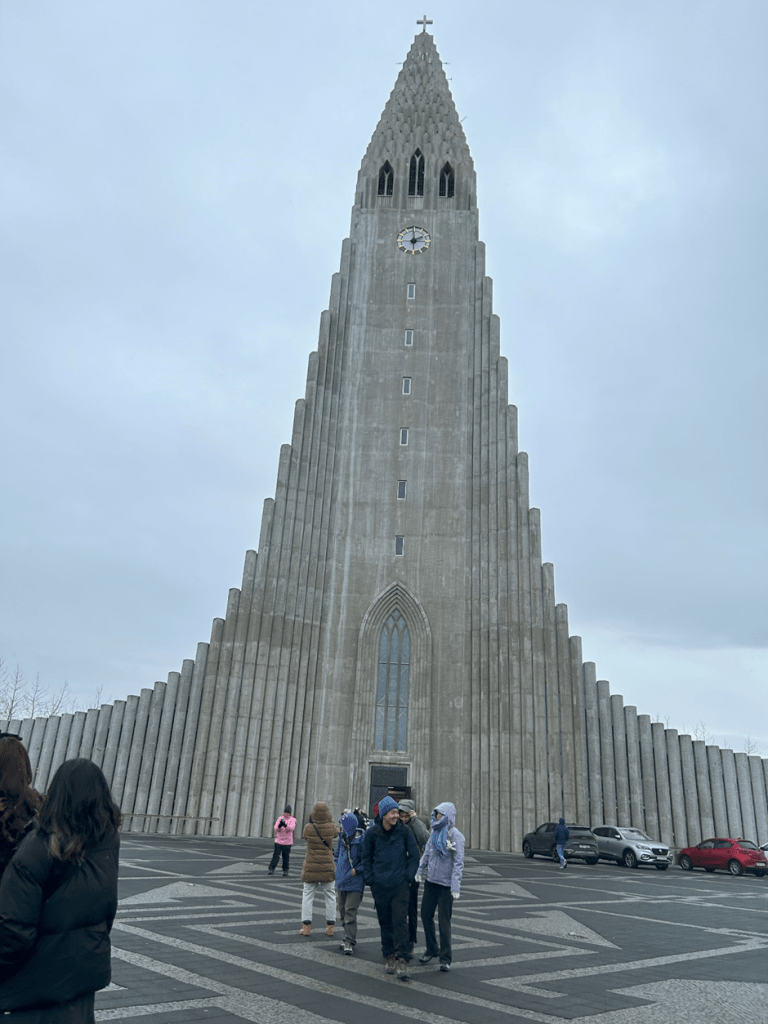
Of interest was the large statue of Leif Erikson, the Norse explorer, who is believed to have set foot in America and is the real discoverer, a million years before Columbus. This statue was a gift by USA to Iceland. Never learnt about him in our history books!!

As we cruised through this tiny city, espying young and old structures, the sun continued to play hide and seek. But the rain and mist had cleared and we were able to soak in the bustling energy of this small town. It is an affluent city, going by the sizes of the cars and houses. Also hugely expensive as most agricultural stuffs are imported. It has a thriving harbor for fisheries and is lined by many tiny shops selling various kinds of lobster dishes.
Before we ended our day, we got an experience of Fly by Iceland. If that conjures an image of a plane ride above Iceland, it is close, but done virtually in 4 D. The theater, first took us through the history of Iceland and then a 4D rollercoaster ride with films of the highlands of Iceland with its majestic mountains, waterfalls, gorges with bountiful of animals and birds. The ride made me dizzy and I hoped that we could see as much in the lowlands we are visiting.
The next day started with a visit to the Rainbow street, laid out in honor of the LGBTQ community. On one end of the street is the Hallsgrim church. The street is flanked by many eateries and shops.

On the way, we were shown the Presidents house, a small nondescript building, with no security cover.
It was going to be a long day as we were to travel about 400 kms to reach almost the northern limits of Iceland to a place called Akureyri. This has about 10% of the population. It is a sea port and has a functioning airport which has services to Greenland.
Our first stop was a waterfall in Nordura river, the Glanni waterfall. In midst of lava fields, it appeared as an oasis, a 3 tier waterfall, bubbling and gushing merrily forward. The pathway to Glanni Falls was covered in slippery snow. The lake into which the waterfall was flowing was white, frothy with chunks of ice. Other than this bustling waterfall, as far as eyes could see it was snow all the way to the horizon, where the greyish sky just blended with the land.
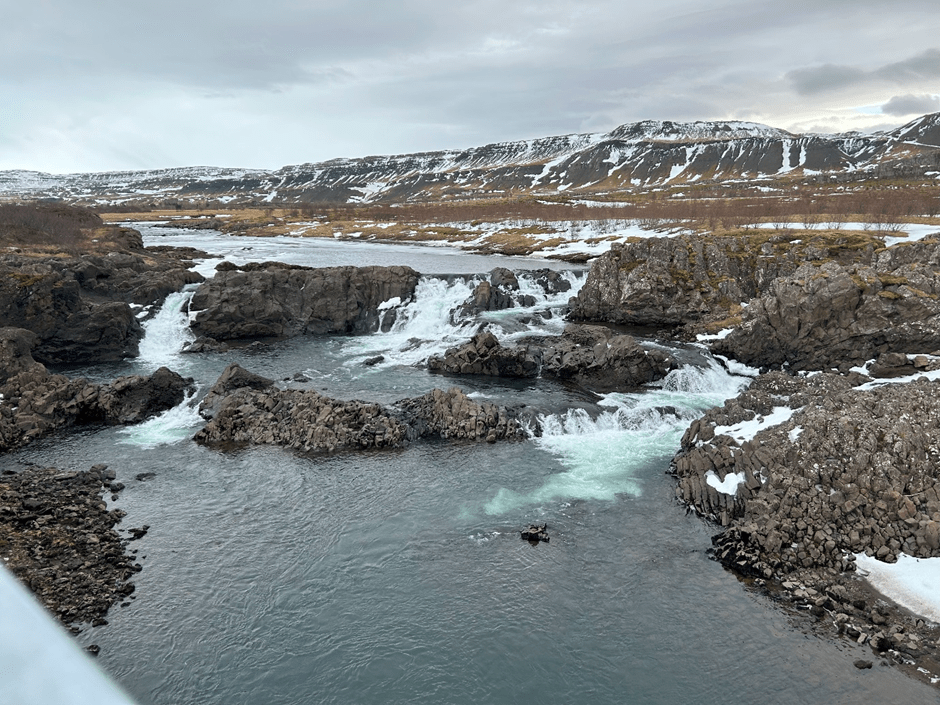
Refreshed with this trek to the waterfall, we continued our journey towards Akureyri.
As we traveled the course of the 400 kms, I could see the landscape changing.
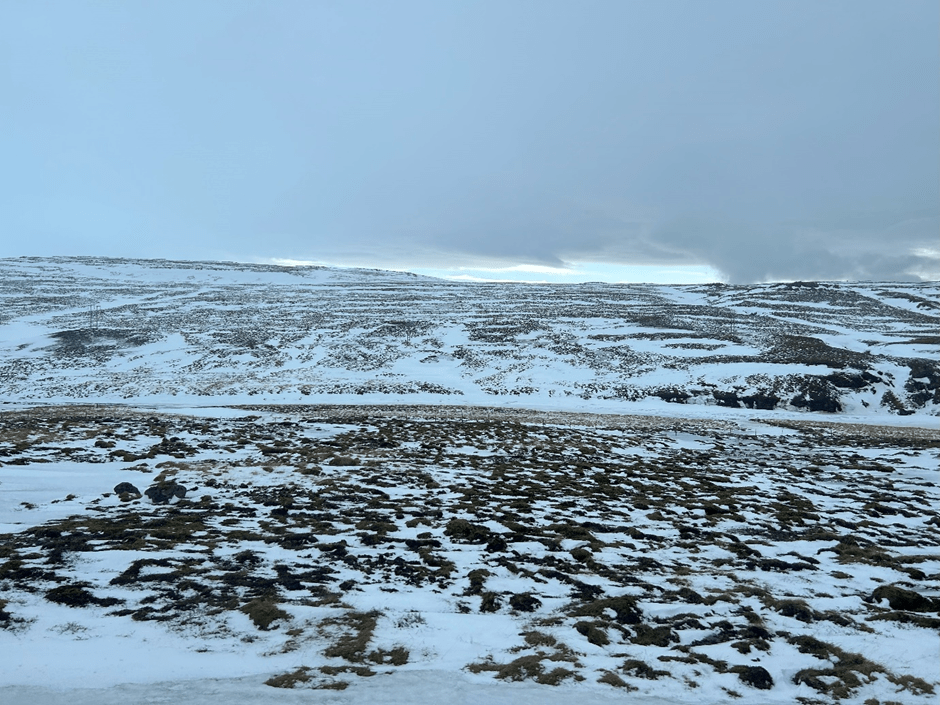
It was black and brown moss-covered rocks as we left Reykjavik. There were hills and mountains and the snow cover on the ground steadily increased. Here and there, we would see frozen lakes, but interrupted in between by a gushing stream, deep Prussian blue and turquoise green and suddenly getting lost under thick ice covers. Still no trees or shrubs but just dried moss on exposed lands. No habitation for miles and miles except few horse farms here and there. We spotted some horses galloping and cantering in some of the farms which did not have much snow cover. These had hairy hooves and lustrous manes, very different from the svelte ones I am used to seeing. Horses from Iceland are rarely if ever taken out of the country, and if done, for competitions or otherwise, they are not brought back. This is to prevent diseases.
I was awestruck at this frigid Martian but refulgent landscape and felt that coming in winter was the right choice to see Iceland truly covered in ice.
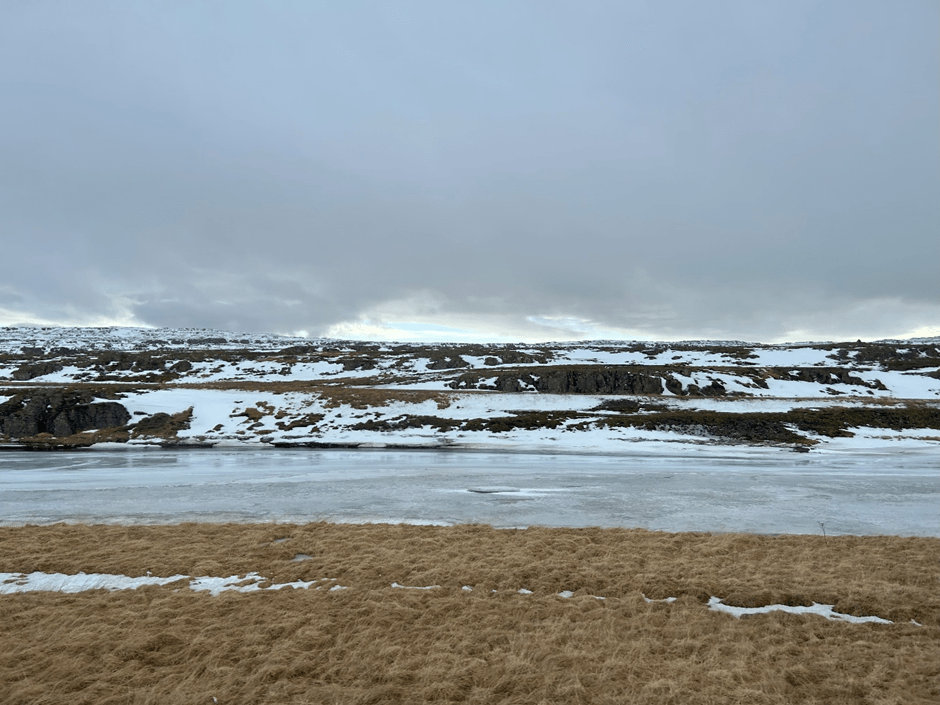
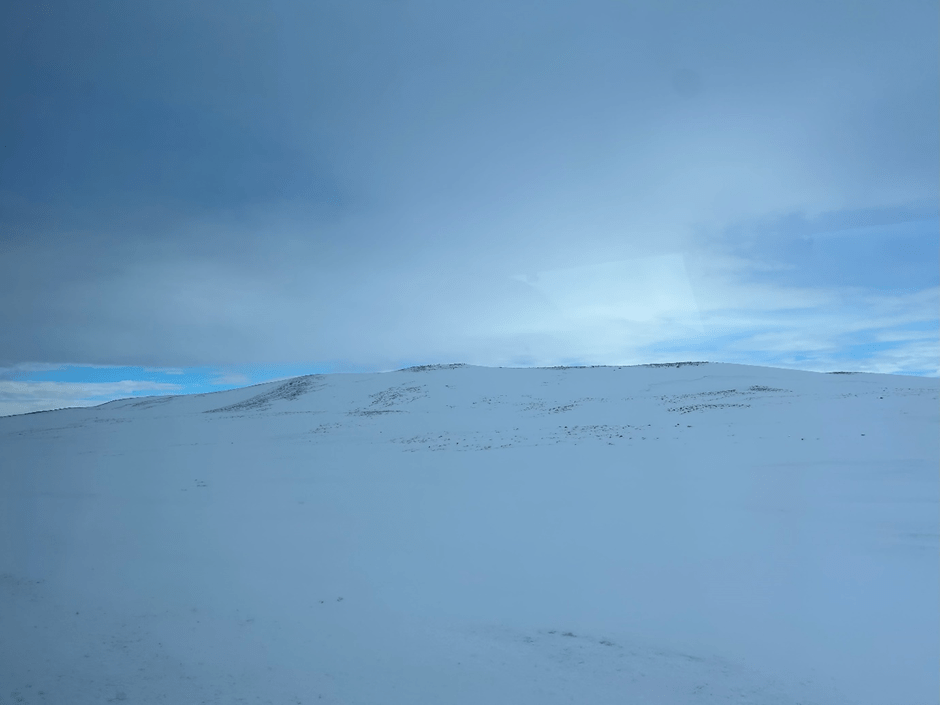
Akureyri was mostly snow covered as well. With the tiny city spread across several hills, with bright houses bringing radiance to the otherwise cold and dreary winters.
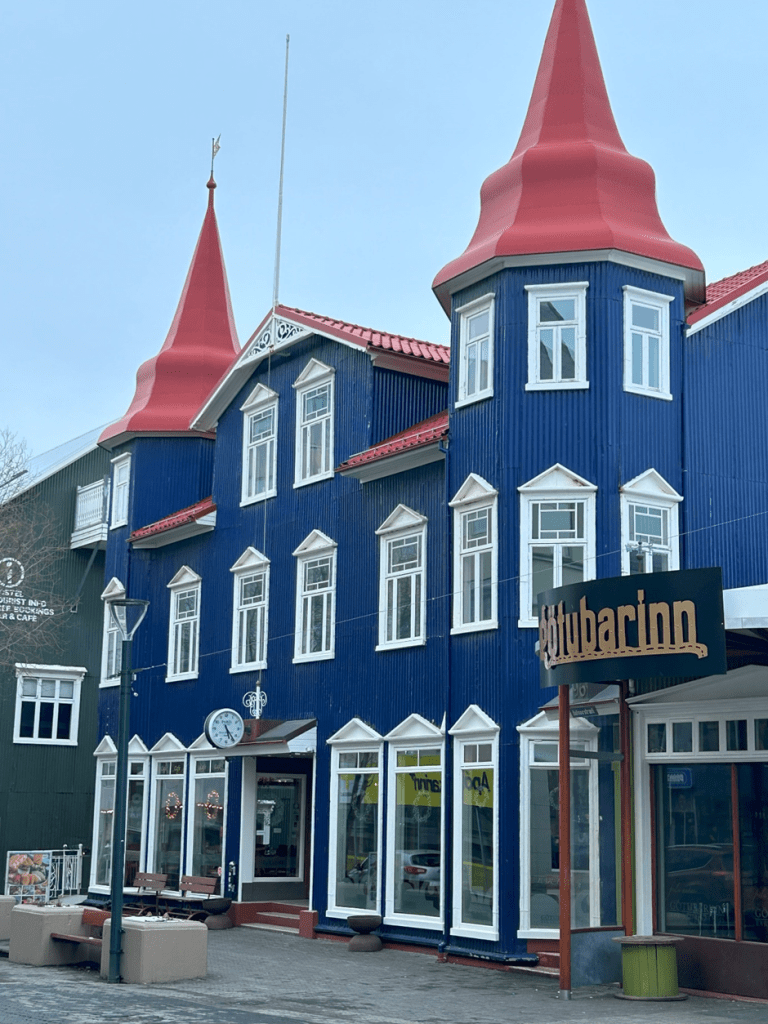
It was already evening by the time we reached our hotel, after a short stop at a shopping center street. Our hotel was surrounded by a wooded forest of birch and pine. I feared wild animals but was told the foxes are only found in the highland and rarely have they seen reindeer in their area. Rabbit and hare might be seen. The thing about Iceland is that the human civilization is only limited to the coastal areas, the lowlands. The highland or the central part is untouched, inaccessible, and is an area of high volcanic activity. The only way you can see it is through the 4D experience which we had earlier.

The tap water smelled of sulphur and I worried I might fall sick.
I slept with the curtains drawn apart. With my eyes fixed on to the little bit of sky I could see. I did not want to miss the Aurora Borealis. We are as north as we can be so maybe today is the night. It was a full moon night and the snow glistened casting an iridescent, white glow all around even at midnight. Not sure when I fell asleep but awoke with chirping of birds. It was still only 4:30 am but I have missed the northern lights. I started to get ready to what is in store for us today.
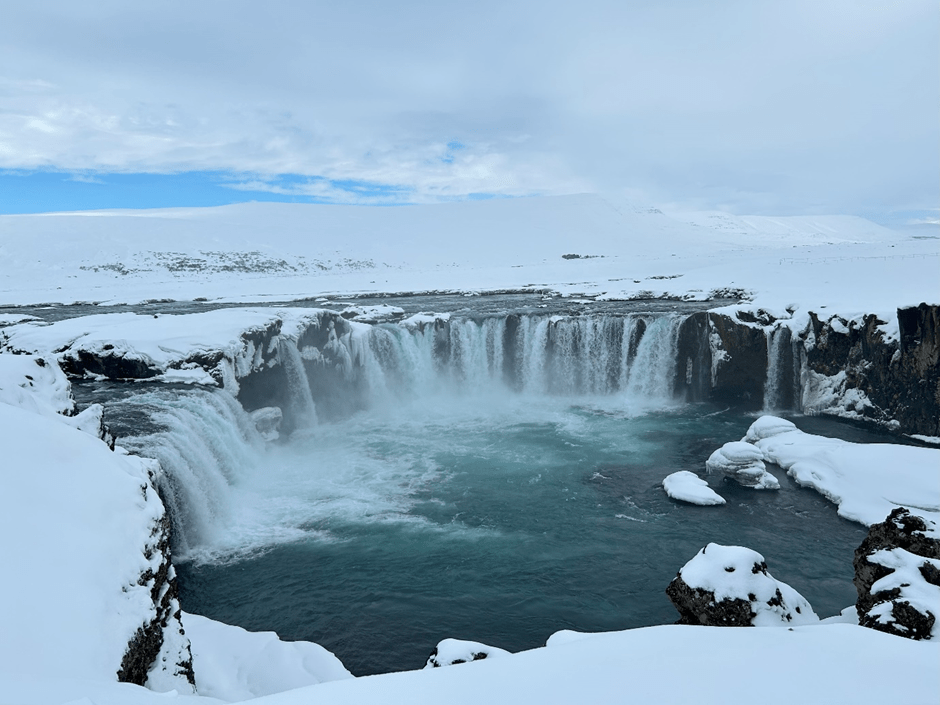
Our first stop was Godafoss, another iconic waterfall, with Norse like columns of water. It was said that the earlier Norse and Viking population were nature worshipers and were forced to Christianity by Norway rulers. The Icelanders destroyed their idols and threw them in the river and all of them collected at the bottom of this Godafoss waterfall. These columns of waterfall fell into a translucent cerulean waterbody which bubbled and gurgled but soon was swept under a mass of thick ice. The polar wind was at its peak and it brought the temperature several degrees below zero. But I was undaunted as I gawked at this scenic beauty and captured both in heart and camera.
From this picturesque fall, we headed towards Myvatn, a shallow lake amidst high volcanic activity. At this time, the lake was completely frozen with no way of knowing where it began and ended. This was surrounded by huge volcanic craters which too were completely covered by snow.
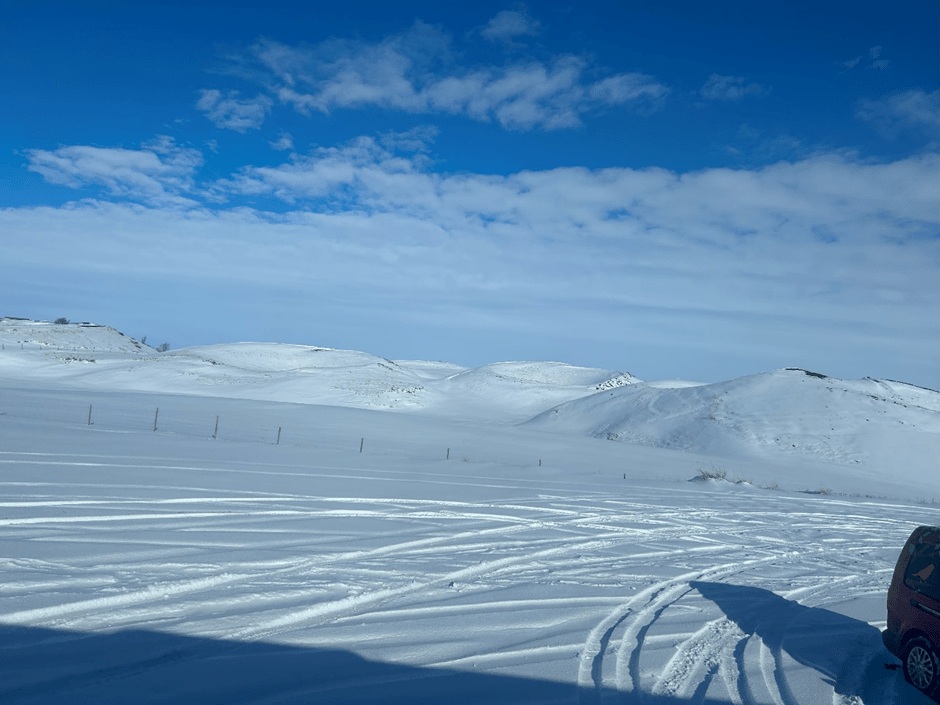
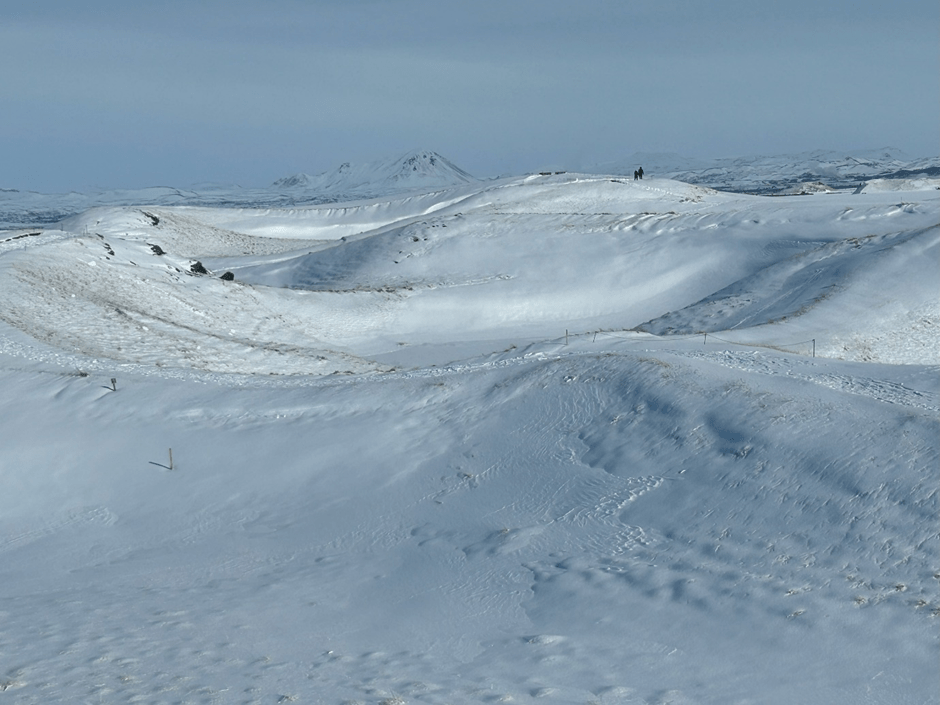
For a while it seemed I am in midst of a white desert with no living soul around. The strong gust of cold wind broke my reverie and we continued to our next stop.
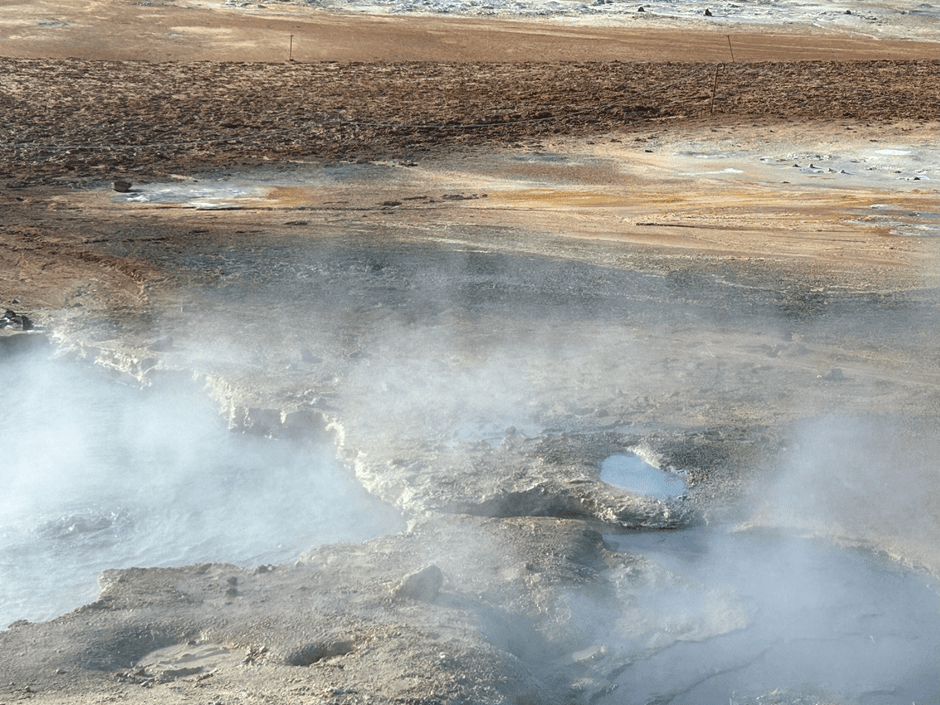
This area always has high volcanic activity, and closeby is Namaskard, a smoldering mudpool emanating hot vapors and strong smell of sulphur. As we stood at the edges of this blistering mudpool, we felt the warmth but quickly dissipated with the howling cold polar winds.
Post lunch, our group gathered at Myvatn Sulphur bath. It was a wonderful and odd experience. While the cold sub zero wind howled all around us, we were standing in hot water of around 35 degrees and felt as if all our tiredness is melting away. Good things end so it was time to pull us out of this warm and relaxed bath and get back to our hotel before nightfall.
Like the night before, I continued my vigil of staring out of the window, unblinking. But maybe I did blink, as when my eyes opened it was morning again and I had missed the northern lights if indeed it did appear.
We checked out of the hotel and began a long journey towards a town Borgarness, which is towards the south of Iceland. Same changing landscape, with the sun shining brightly but to me it always seemed to be at the 4 o’ clock position. We stopped at a small town Bondhous. I bought a water bottle. The smell of sulphur from the tap waters had turned me off.
We were going to the Langjokull Glacier base camp. Langjokull is the second largest glacier in Iceland and named as it is “long”. From the base camp we undertook a 2 hour perilous journey on a monster truck to the Glacier to visit an ice cave.
By now there was a full blown snowstorm raging all around with zero visibility. It was the skill and perseverance of our driver Magdalena and the jovial guides which kept our spirit up. It took more than an hour to reach the ice cave. The ice cave was a wintry wonder with tunnels and small rooms carved in along with a chapel. I was apprehensive about the raging storm. It took more time to get back to the base time than it had taken to reach there. By the time we alighted at the base camp, I felt that we really had put our limb and life in danger today.
We continued our onward journey towards Borgarness and stopped at two other waterfalls, Hraunfossar and Barnafoss. The sun was out and it cast a beautiful semicircular rainbow.
Borgarness is another quaint coastal city. It is a harbor city with lights from the harbor and streetlights keeping the night away. I decided that in this condition, there is no chance of the northern lights, so slept peacefully.
Woke up in the morning and went out to breathe the pure scented air. It was drizzling slightly, but temperature was above zero degrees so felt comfortable.
After breakfast we headed towards two equally magnificent falls. The first one was Seljalandfoss. A massive, cascading, milky waterfall with a gusty drop from about 60 meters. The wind was so strong that as we stepped closer, I was completely soaked. The unique thing about this one is you can go behind the waterfall but the pathway was covered by slippery ice.
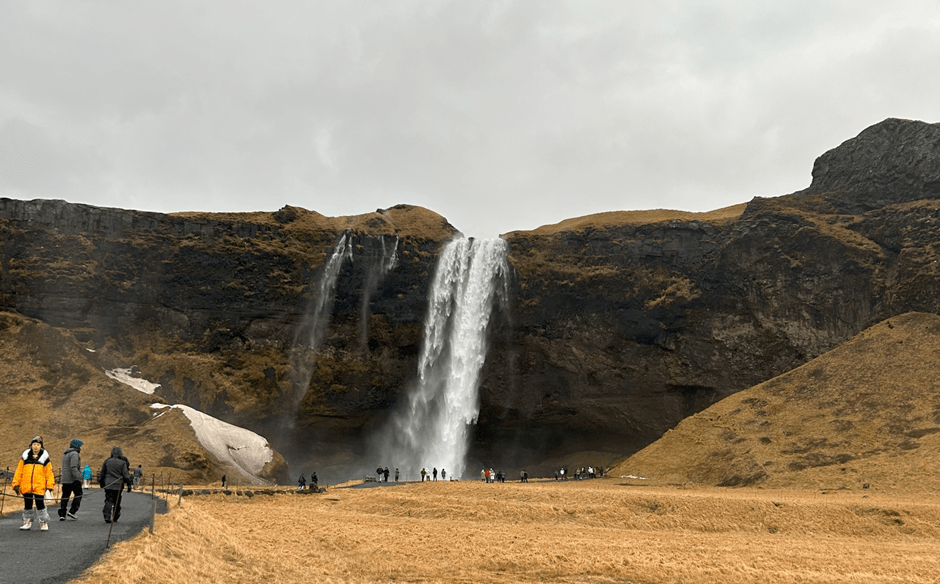
From this one to the next massive one, the Skogafoss. As if it tried to outdo the other one with a drop more than 60 meters and equally powerful, massive, daunting, yet with a rugged beauty emanating from the resplendent milky waterway. Here too I got drenched from the powerful spray.
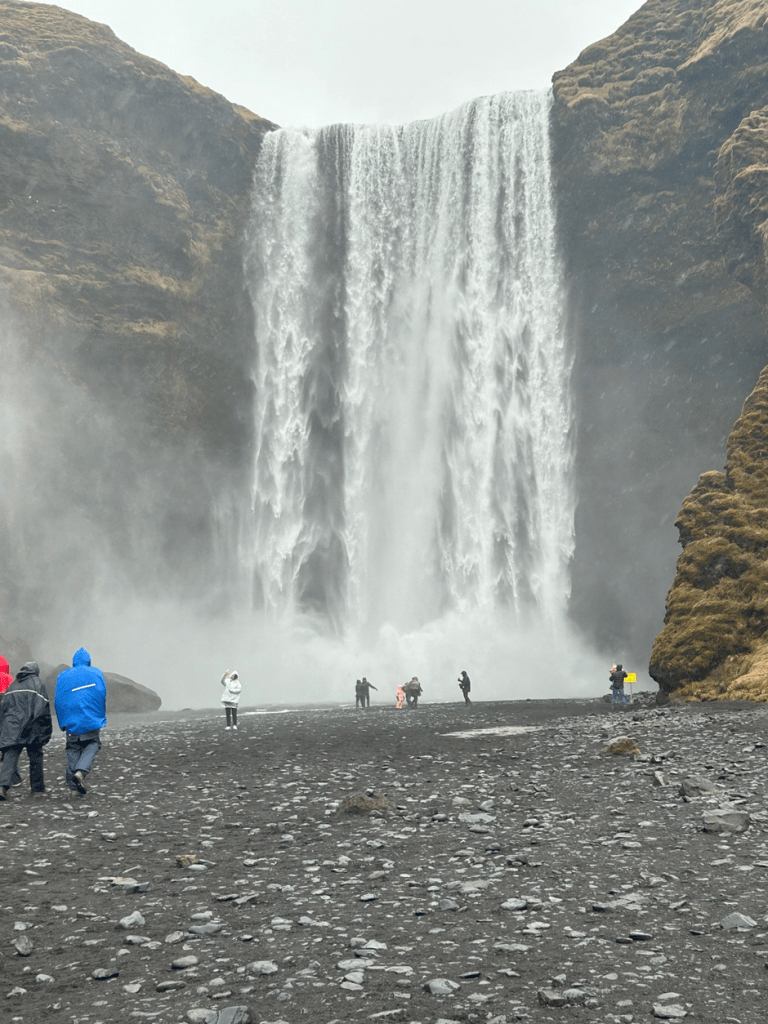
Our next stop was the black sand beach. I had never seen a place displaying such natural ferocity with the gigantic, roaring Atlantic waves breaking on to the massive columns of basaltic and granite rocks and boulders. The wind seemed to play a role in increasing the viciousness of the surrounding by blowing so hard that I was getting pushed towards the sea, if I didn’t have someone or something to hold on to. The beach was layered with basalt deposits not the usual sand. Finding it difficult to stand erect against the wind, I felt that I was being pushed towards those massive waves which would soon engulf me and sweep me away. The roar of the monstrous waves and the screeches of the powerful wind was causing so much of din that conversing, standing, or even keeping our eyes open, was difficult.
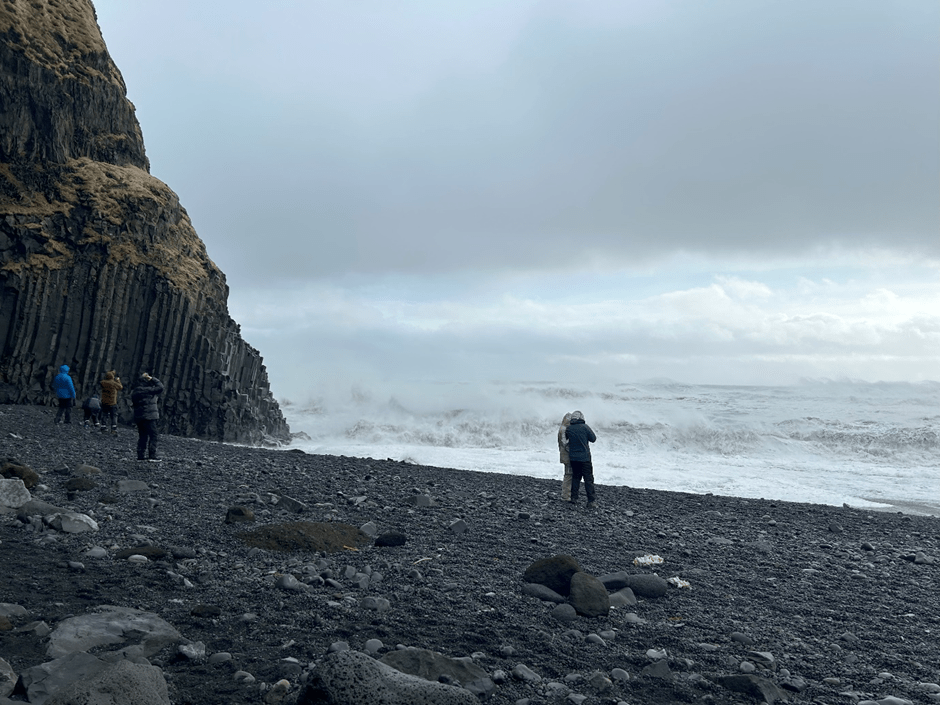
We concluded our trip for the day. I have now seen the feral side of our earth. A blistering and blinding snowstorm and the cyclonic wind were enough to make me feel timid and humble in front of the force of nature.
We reached Vik, this is on the southern tip of Iceland. Here is where I had my tryst with the Northern Lights. I was trying to sleep, grateful that I survived nature’s fury, and back in a warm and comfortable confines when whoops of joy from outside revealed that Northern Light has been sighted.
Grabbing the woolens, I raced out and saw the beholding sight. But it was fleeting and disappeared as soon as you believed that it was indeed it.
It was so fleeting that I had to use my camera and click the pictures, with slow shutter speed and large exposure, to believe and make others believe that it was really there.
We were back in Reykjavik completing the circle. We learnt that there is going to be high chances of Northern Lights that night, and lo and behold, just 2 steps away from our hotel, the sky lit up with the translucent green lights. This time it wasn’t fleeting but was there for a long time.
We decided to go away from the city to the wilderness and reached a spot where there were many other tourist vehicles. It was a full moon day, the snow cast land shown in a bright silvery light and the trees stood silently with shiny silhouettes.
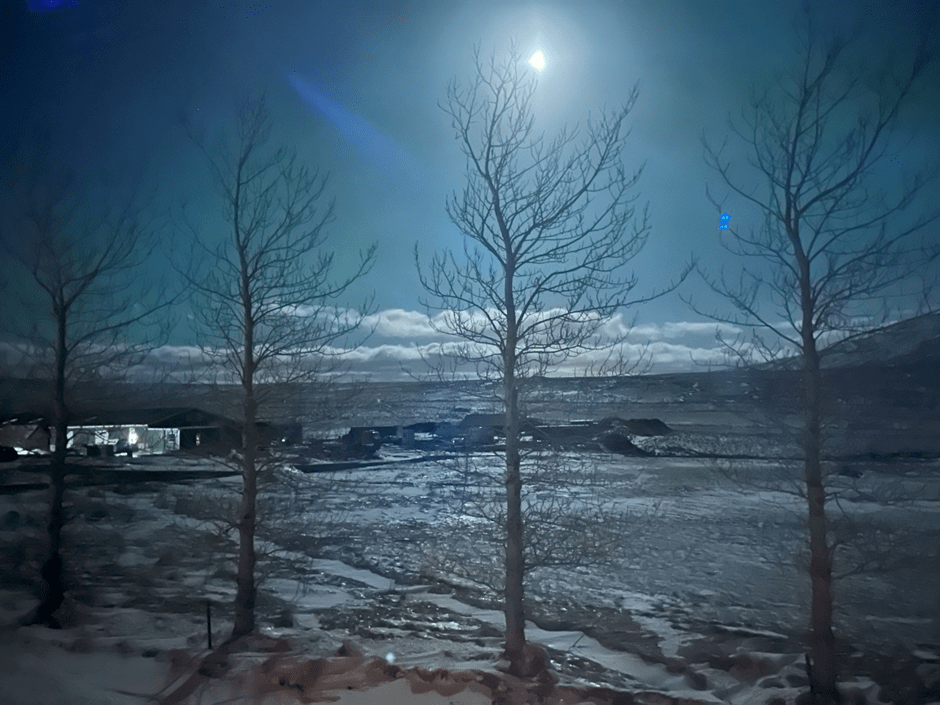
The tourist population was predominantly Asians. The temperature was -4 degrees and with Feels Like of -8 degrees but our enthusiasm had no bounds. We waited and waited but couldn’t see anything so started our journey back. But as we neared the city, the sky lit up again, this time with much more intensity. We had the bus stop and merrily clicked pictures and gaped at the colorful display. It is said that one is fortunate to see this natural event and now I do believe so.
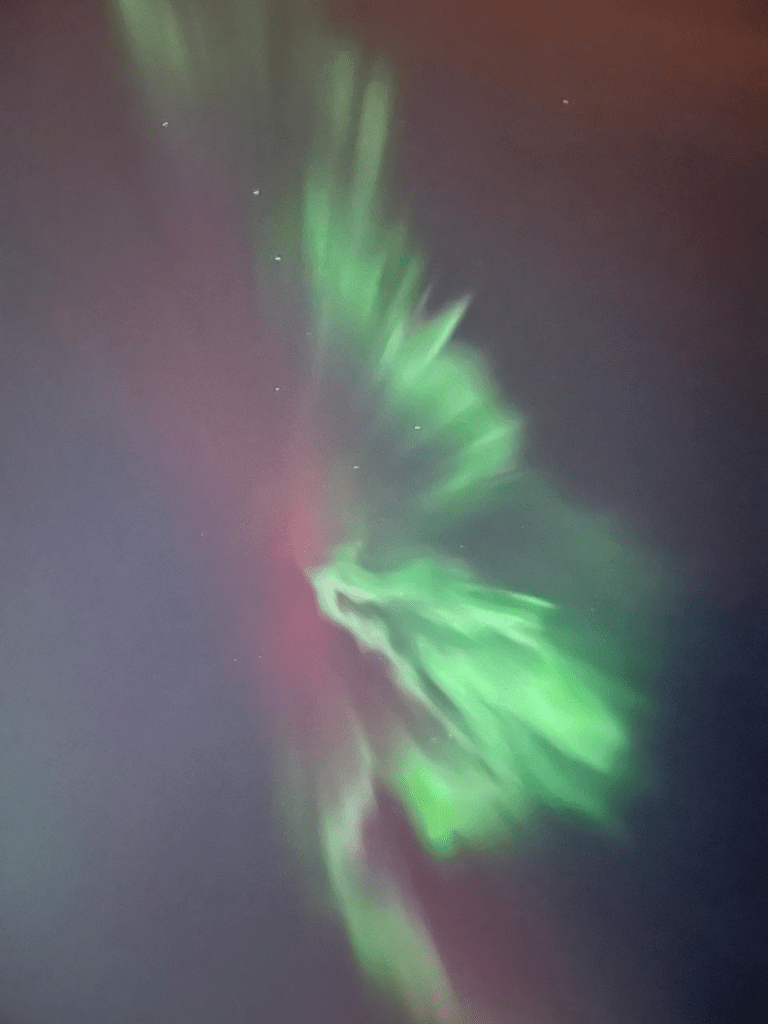
Seeing this marvelous sight, I felt gratified. My lifelong dream realized and worth the trouble, travails and sometimes the arduous journey.
We had one more day to go and had still more places to tick off in our itinerary. But I was already feeling upbeat as if the vision of northern lights was all that I wanted ever.
We visited Pingvellir and Geysir and then Sky Lagoon in the afternoon.
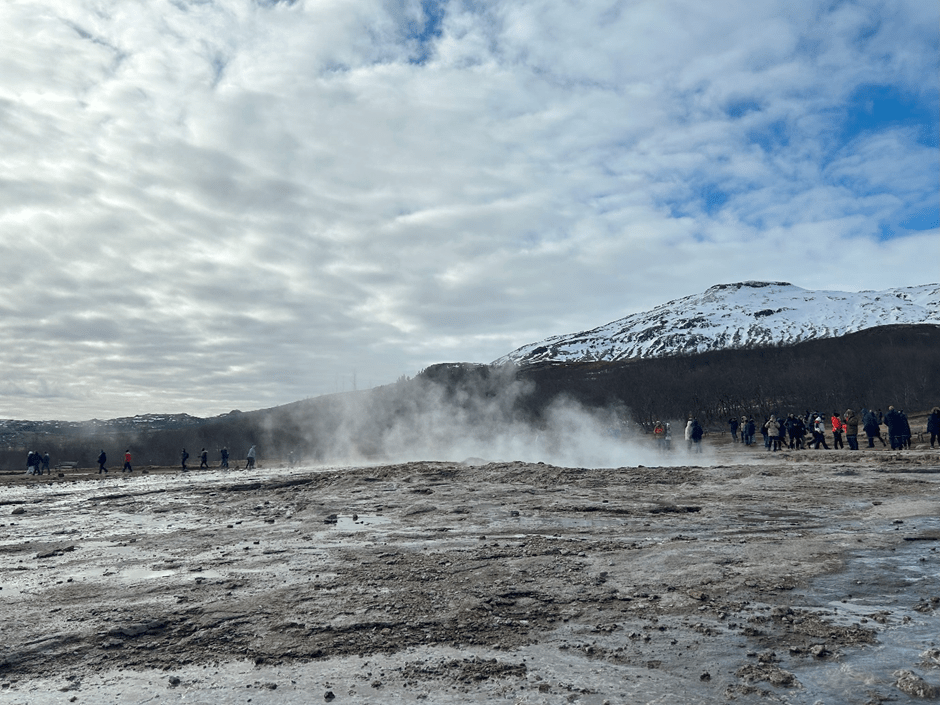
Pingvellir is again an area of high volcanic activity and is a world heritage site. It is the place where we saw the Parliament, Althing, the oldest in the world, built in 930 AD by the Norsemen. The national park is in a rift and as you walk through one can see the layers of tectonic plates over the ages. A short distance from Pingvellir is Geysir, the hot spring. We saw several of them with white vaporous fumes coming out. I waited patiently and was rewarded with one of them suddenly bursting and rising 30 feet above ground and then fall back to be dormant for a while but still with smoldering white smokes.
Our final stop of the day was a waterfall Gullfloss. Also known as Golden Falls it is a 3 tier fall from river Hvita as it meanders through the arid land, drops sharply in 3 places giving a gorgeous view of a delightful scene.
In between we visited Sky Lagoon which we were told is a suphur pool from the waste water of the hydroelectric plant and underwent the 7 step process of purification. Plunge into the hot pool overlooking the Atlantic. Like Myvatn, this too was eerie, with cold wind blowing all around and me submerged in hot water. Out of the hot water was sun bath, cold water sprinkle bath, dab in moss extracts and then enter the sauna. Purified and freshened up guaranteed a peaceful deep sleep at night.
I bade goodbye to this enigmatic land, pleased that I could visit it in its wintry glory and grateful that I could see its natural charm. More importantly, my tryst with the Northern Lights, was the highlight of this journey and firmly etched in my memry.
Till I visit you again!
 TheEbbandFlow